There is a specific kind of existential dread reserved for anyone who has ever been stuck in a suburban office building after 6:00 PM. You know the vibe: the aggressive hum of a fluorescent light bulb that sounds like a mechanical mosquito, the damp scent of mystery-moisture trapped under cheap carpet, and wallpaper the exact colour of a sad turnip.
Enter Kane Parsons (the 20-year-old YouTube wunderkind known online as Kane Pixels), who looked at this specific aesthetic aesthetic nightmare and said, “Yes, let’s make a two-hour movie out of this, back it with A24 money, and trap Oscar nominees in it.”
The resulting film, Backrooms, is a masterclass in making absolutely nothing happen for an hour, making you utterly terrified of that nothingness, and then giving you a third act that will either make you want to buy the director a drink or hurl your popcorn at the screen.
The Plot: Capt’n Clark’s Bedtime Blunder
Set in the early 1990s, the film follows Clark (Chiwetel Ejiofor), a failed architect who has reached a level of rock bottom that feels aggressively personal. To pay the bills, Clark manages a sprawling, aggressively vacant discount furniture store called Cap’n Clark’s Ottoman Empire. He stars in his own local TV commercials dressed as a pirate, despite knowing deep in his soul that an Ottoman empire requires a sultan, not a buccaneer. It’s a linguistic crisis that mirrors his emotional state.
Because Clark is broke and divorced, he sleeps in the store’s display beds. One night, while wandering the cavernous basement, he accidentally “clips” through a section of the wall—exploiting a glitch in reality like a broken character in a video game—and plummets into the Backrooms.
What are the Backrooms? It’s an infinite, non-Euclidean maze of empty office corridors, mismatched doors, and dead ends that looks like Salvador Dalí got a job at a corporate real estate firm. Naturally, Clark doesn’t keep this to himself. He gets his therapist, Mary (Renate Reinsve), involved. Mary is a gentle soul haunted by childhood trauma who markets her own self-help cassette tapes. Before you can say “unprofessional boundaries,” Mary enters the maze to find him, and both get hopelessly lost in a universe of endless beige.
-
 Backrooms Poster Wall Art A5 A4 A3 Super High Quality Photo Paper Design 2Price range: £7.99 through £14.99
 -
 Backrooms Poster Wall Art A5 A4 A3 Super High Quality Photo Paper Design 1Price range: £7.99 through £14.99
The Critical Consensus Breakdown
To understand how Backrooms is dividing the planet, we have to look at the numbers. Internet film circles are currently locked in a civil war.
On Rotten Tomatoes, critics are absolutely swooning over the film’s “liminal horror” aesthetic, awarding it an impressive 88% Fresh rating. They are treating it like the second coming of David Lynch or Stanley Kubrick. Meanwhile, the Audience Score sits at a much more hesitant 74%. Why the gap? Because critics love “vibes,” and audiences generally prefer a movie that actually has an ending.
Over on IMDb, the rating holds a steady but deeply contested 7.3/10, bogged down by furious users who left the theater asking, “Wait… so that’s it?” Screen Rant and other major outlets have praised the film’s incredible performances but noted that the narrative structure is “as thin as the drywall Clark walks through.”
| Platform | Score / Metric | The Verdict in Plain English |
| Rotten Tomatoes (Critics) | 88% | “An icily brilliant, boundary-pushing masterpiece of psychological dread.” |
| Rotten Tomatoes (Audience) | 74% | “The first hour was terrifying, but the ending gave me homework.” |
| IMDb | 7.3 / 10 | “Great acting, amazing atmosphere, please explain the monster.” |
| Metacritic | 77 | “Visually spectacular, narratively deeply confusing.” |
The Atmosphere: Terror by Tupperware
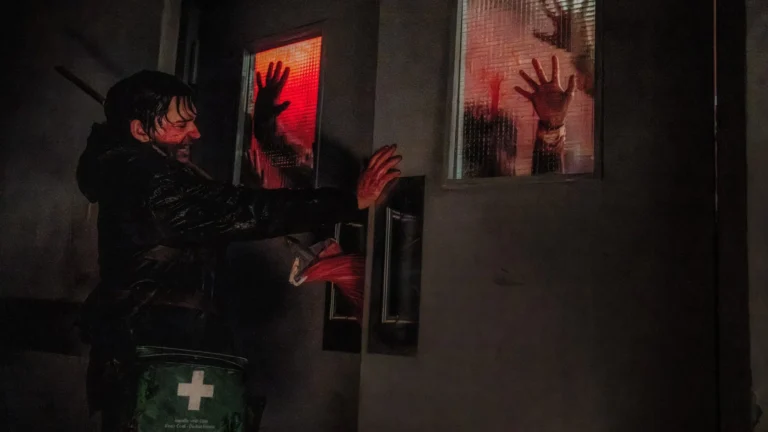
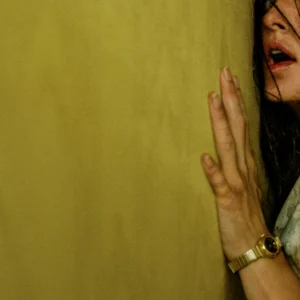
What Parsons gets entirely right—and what matches the genius of his original viral YouTube shorts—is the atmospheric horror. Alongside cinematographer Jeremy Cox, Parsons uses wide-angle lenses and grainy, period-accurate VHS footage to make the environment feel actively hostile.
The production design by Danny Vermette features a massive, 30,000-square-foot practical set. The film trusts silence. There are no cheap jump scares where a cat jumps out of a cupboard. Instead, the horror comes from looking down a long hallway, seeing a door that shouldn’t be there, and listening to the low-frequency bzzzzzzz of the ceiling lights. The score, co-composed by Parsons and Edo Van Breemen, sounds less like music and more like the internal groan of a dying building. It creeps into your jawline and stays there.
Ejiofor and Reinsve do the heavy lifting here. They don’t resort to classic, wide-eyed “horror movie acting.” Instead, they give us shocked, exhausted silence. When Clark explains the Backrooms, he says it’s like trying to describe a dog to someone who has never seen one, and then asking them to draw it: The basics are there, but the details are deeply, horribly wrong. —
The Third Act: Where the Drywall Crumbles
If the first two-thirds of Backrooms are a brilliantly claustrophobic exercise in environmental dread, the final third is where the film tries to build a conventional plot, and unfortunately, it uses some pretty shaky scaffolding.
The script tries to establish that the Backrooms are a psychological metaphor for Clark and Mary’s trauma. “We all have our loops,” Mary notes, because apparently, an infinite dimension of yellow wallpaper isn’t scary enough without a Intro to Psychology lecture attached to it.
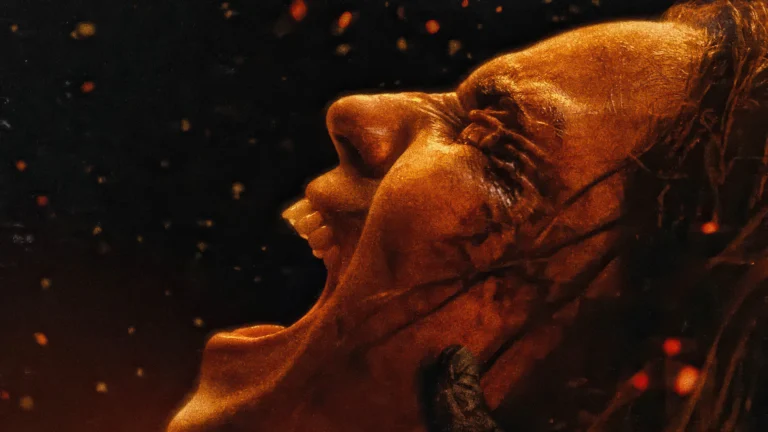
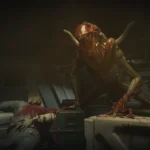
Then come the entities. The film introduces “Still Life” monsters, and depending on your tolerance for internet lore, this is either the peak of the movie or where it completely derails. As one hundred years of cinema history have taught us, the monster you imagine in the dark is always infinitely scarier than the CGI puppet the director actually shows you. Once the threat shifts from “I am trapped in an impossible, infinite void” to “I am running away from a weird zombie guy,” Backrooms momentarily loses its psychological edge and becomes a standard A24 funhouse ride.
We also get a baffling supporting appearance by Mark Duplass as a scientist from the Async corporate agency, which injects a heavy dose of sci-fi mythology into a movie that was working perfectly fine as a surreal dream. It leaves audiences with far more questions than answers, leading to theaters full of people staring blankly at the credits, trying to text their smartest friend for an explanation.
The Final Verdict
Backrooms is an undeniable milestone for internet-born horror. For a 20-year-old director to step up from Blender software animations to a studio-backed feature film and manage to extract powerhouse performances from world-class actors is nothing short of miraculous.
It is atmospheric, deeply unsettling, and visually unforgettable. If you are willing to meet the film on its own terms—meaning you don’t mind a movie that refuses to spoon-feed you answers and functions primarily as a two-hour panic attack—you will love it. If you require a neat, tidy conclusion where the mystery is solved and the characters live happily ever after, you will likely leave the theater feeling deeply scammed.
It doesn’t completely stick the landing, but as a sightseeing tour through a glitching reality, it is well worth getting lost in.
The Aggregated Expert Score: 7.8 / 10
For a deeper look into how this viral internet phenomenon made the massive leap from a teenager’s bedroom to Hollywood, you can check out this A24 Backrooms Movie Review. This video breaks down how the film expands on the original internet mythology while keeping the core atmospheric dread alive for mainstream audiences.