We have all been there. You are hopelessly, excruciatingly in love with your best friend. She is bubbly, charismatic, and about to leave her dead-end job to pursue bigger things. You, conversely, order piña coladas at the local pub because you “don’t like the taste of alcohol” and possess the romantic confidence of a damp cardboard box.
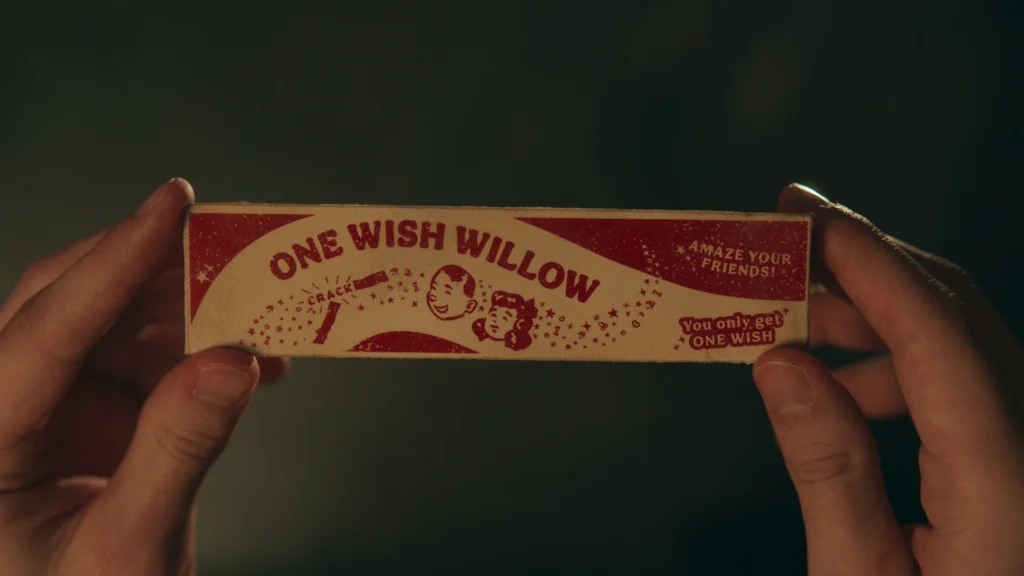
Naturally, when it comes time to buy her a parting gift, you bypass standard options like a nice notebook or a gift voucher. Instead, you wander into an alternative shop smelling deeply of unearned spiritual superiority and purchase a cheap novelty item called the “One Wish Willow.” You break it, make a wish that she would love you back, and hope for the best.
What could possibly go wrong?
According to 26-year-old wunderkind director Curry Barker, absolutely everything.
Obsession is a masterfully unhinged, blood-soaked, and darkly hilarious take on the classic “Monkey’s Paw” archetype. Made on a shoestring budget of roughly $750,000 before being snapped up by Focus Features and Blumhouse, it has managed to do what multi-million-dollar studio blockbusters consistently fail to achieve: keep an audience completely frozen in a state of shared, chest-tightening tension while simultaneously making them bark with nervous laughter. It takes our deeply hardwired, universally relatable desire to be loved and stretches it into a grotesque nightmare.
The Plot: Be Careful What You Wish For (Seriously)
The film opens with a vibe that screams mid-2000s teen drama. We meet Bear Bailey (Michael Johnston), a textbook “nice guy” who has spent years silently pining after his coworker and best mate, Nikki (Inde Navarrette). They are part of a tight-knit quad of twenty-somethings who spend their evenings dominating local pub trivia nights. The dialogue here is sharp, subtle, and incredibly natural. Barker sprinkles quiet nuances into their interactions that build genuine affection before the floorboards are ripped out from underneath the narrative.
When Nikki announces she is quitting, Bear’s desperation peaks. Enter the aforementioned One Wish Willow. Bear cracks it, wishes for Nikki’s heart, and presto! The universe complies with terrifying efficiency.
Initially, it feels like a victory. Nikki starts noticing Bear. She loves his clothes. She loves his flat. She loves his scent. But very quickly, the volume on Nikki’s affection gets cranked past ten, through the roof, and straight into the outer stratosphere. Her admiration mutates into an aggressive, all-consuming addiction. Nikki doesn’t just want Bear; she needs him with the manic, sweaty desperation of a physical dependency.
What follows is a delightfully twisted descent into extreme psychological control, severe boundary dissolution, and eventually, visceral violence. The film brilliantly explores the concept of the “ideal partner” taken to its absolute, logical extremity—resulting in a cautionary tale that acts as a profound, troubling mirror to modern entitlement and the sheer horror of unchecked male longing.
Performance Review: The Navarrette Force of Nature
While Michael Johnston plays the vulnerable, increasingly terrified Bear with pitch-perfect “straight-man” energy, Obsession entirely belongs to Inde Navarrette.
The Performance Spectrum
- Pre-Wish Nikki: Charismatic, kind, independent, and completely out of Bear’s league.
- Post-Wish Nightmare: Scene-chewing, erratic, intensely volatile, and screaming “Why don’t you love me?!” at the top of her lungs.
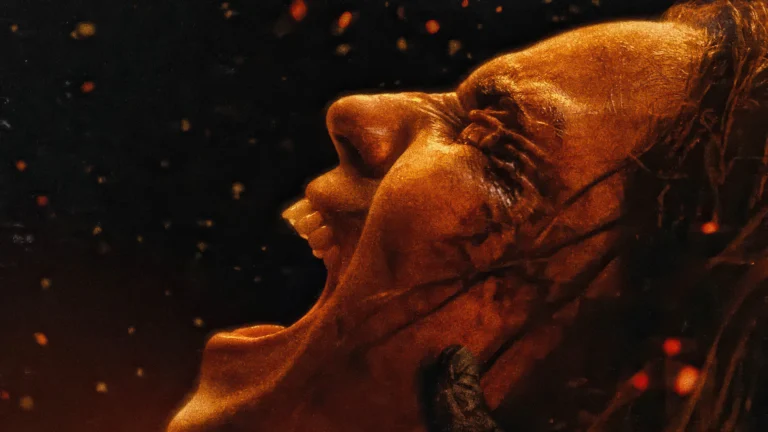
Navarrette delivers what is easily one of the most electrifying and unhinged horror performances of the decade. Watching her transition from a grounded, sweet young woman into a codependent psychological terror is hypnotic. She doesn’t just act; she weaponizes her facial expressions. When she smiles, it is subtly too wide—evoking the uncanny valley of a creature wearing a human mask. When she cries, it feels like an otherworldly monster is wailing just beneath her skin.
The sheer unpredictability she brings to every frame keeps the audience perpetually off-balance. One moment she is cooking a domestic dinner; the next, she is screaming with a ferocity that will live rent-free in your nightmares for months. It is a star-making turn that holds the film’s more ridiculous premises together by sheer force of will.
Direction, Atmosphere, and the Art of the Awkward
Curry Barker’s direction is startlingly confident for a feature debut. A lot of modern horror directors confuse “scary” with “blindingly dark.” Recent genre offerings have been heavily criticized for shooting night sequences so poorly that audiences spend the third act squinting at a muddy screen.
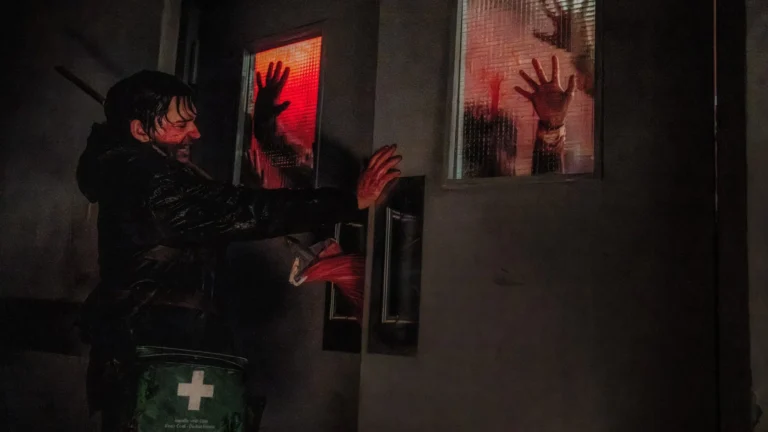
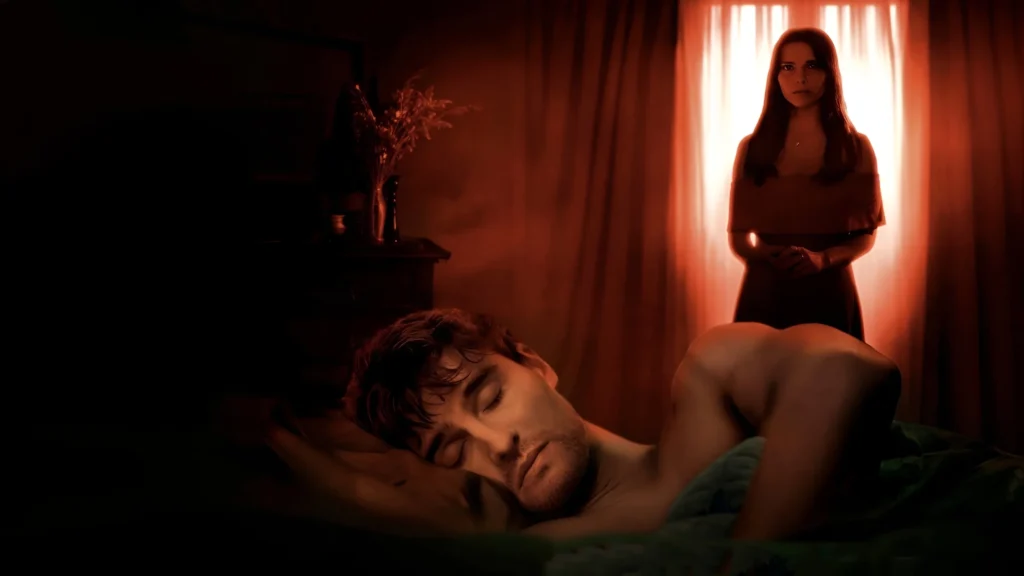
Barker and his cinematographer, Taylor Clemon, take note of this and turn the darkness into a weapon. In one genuinely spine-chilling sequence, Bear wakes up in the middle of the night to find Nikki standing perfectly still in a pitch-black corner of the bedroom, just watching him sleep. Because of the expert lighting, you can barely make out her face. Your eyes squint to find her expression, while your brain actively screams at you to look away. It’s simple, old-school atmospheric dread that relies on framing and performance rather than digital trickery.
Furthermore, the script shines brightest in its handling of social awkwardness. The horror in Obsession isn’t just about blood or monsters; it’s the visceral discomfort of a domestic dispute that has spilled out into the open. It captures the exact, agonizing feeling of watching a couple violently argue in a public parking lot or a restaurant, leaving you trapped in the crossfire of someone else’s dysfunction. Barker weaves this awkward social comedy seamlessly with intense outbursts of gory violence, creating a tone that lets you laugh out loud right before a jump scare punches you squarely in the throat.

The Flaws: A Slightly Saggy Final Act
Is Obsession perfect? Not quite.
At 108 minutes, the film slightly overstays its welcome in the final act. Because the central premise relies on a repetitive cycle of escalation—Nikki does something crazy, Bear tries to manage it, Nikki does something crazier—the momentum begins to drag just before the climax. It occasionally feels like a tightly wound 90-minute thriller that was stretched out to hit a standard theatrical runtime.
Additionally, because the movie initially grew from modest roots, eagle-eyed viewers will spot a few technical constraints. A couple of the prosthetic corpses and visual gags (including a highly debated scene involving a shower of money falling from the sky and a notably stiff ragdoll in a car crash) look decidedly “indie.” However, rather than breaking immersion, these moments actually contribute to a charming, midnight-movie aesthetic reminiscent of classic anthology horror like The Twilight Zone or Creepshow.
Critical Consensus: What the Internet is Saying
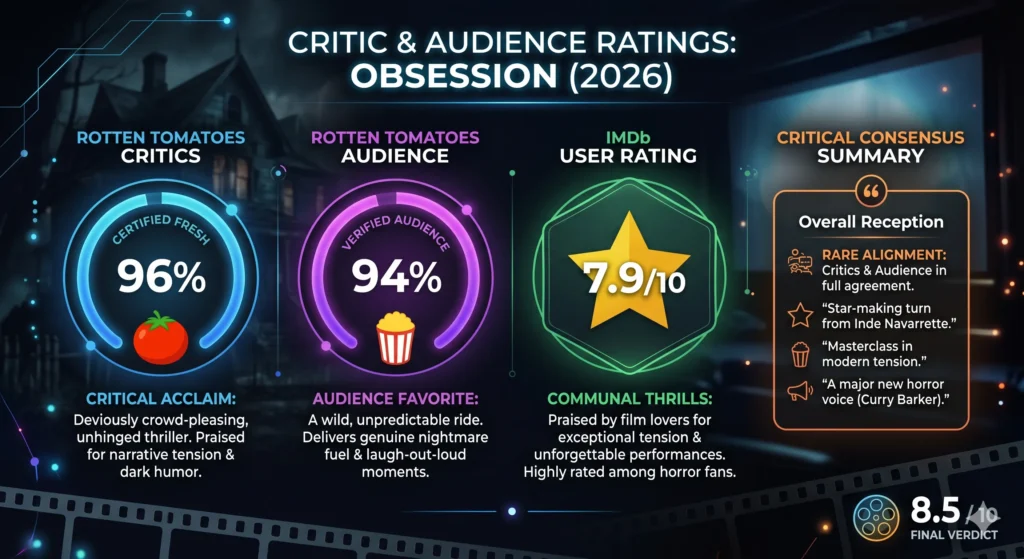
The internet has universally flipped its collective lid over this film, achieving a rare, harmonious alignment between critics and audiences across major tracking sites.
Critic and Audience Metrics
- Rotten Tomatoes Critics Score: 96% (Certified Fresh)
- Rotten Tomatoes Audience Score: 94% (Verified Audience)
- Internet Movie Database (IMDb): 7.9 / 10
Critics on Rotten Tomatoes have lauded it as a “deviously crowd-pleasing” thriller. While a few outlier reviews have criticized it as mean-spirited, the vast majority praise its thematic weight regarding bodily autonomy, obsession, and consent.
Over at Screen Rant, reviewers are calling Curry Barker one of the most exciting new voices in the horror genre, drawing highly favorable comparisons to Zach Cregger’s work on Barbarian. They note that the film’s extraordinary box-office hold—growing in ticket sales week after week via pure word-of-mouth—is a phenomenon rarely seen outside of massive studio blockbusters.
Meanwhile, users on the Internet Movie Database (IMDb) are completely obsessed with the communal theater experience. User reviews consistently praise it as a wild, unpredictable ride that delivers genuine nightmare fuel alongside pitch-black humor, proving that audiences are hungry for original, high-concept horror.
Final Score & Verdict
Obsession takes an age-old cautionary trope and injects it with fresh, modern malice and exceptional dark humor. It proves that you don’t need a hundred-million-dollar budget or a CGI monster to terrify an audience; you just need a deeply relatable human insecurity, a pitch-black script, and an actress willing to look absolutely terrifying under a bedroom spotlight.
It is uncomfortable, it is messy, and it will ensure you never look at a homemade sandwich quite the same way again (if you know, you know). Go see it with a packed crowd—and maybe think twice before buying your crush anything from a shop that sells incense and spiritual rocks.