Predator: Badlands – The Hunt Evolves in the Dust
There’s a particular satisfaction in watching a Predator movie that actually remembers what made the original stalk through pop culture like a thermal-vision fever dream. Predator: Badlands, thankfully, does just that — it steps out of the cramped cityscapes and overused jungle settings and instead drags the galaxy’s most efficient trophy hunter into the blazing furnace of the desert.
It’s a move that sounds simple, but in a franchise that’s been wandering in narrative circles for decades, it feels oddly refreshing. The Badlands setting turns out to be more than just an aesthetic pivot; it’s a thematic one too. Gone are the tangled vines or skyscraper shadows. This time, there’s nowhere to hide. Just open land, blazing sun, and the sound of something heavy breathing behind you.
A franchise that refuses to die
Let’s be honest: Predator as a brand has had a bumpier ride than a US Navy chopper flying into Val Verde. After the perfect chaos of the 1987 original, we got the grimy fun of Predator 2, the surprisingly clever Predators (2010), and then The Predator (2018)—a film so tonally confused it felt like three genres smashed together in a blender, left on overnight, and garnished with a dash of wasted potential.
So when Badlands was announced, there was doubt. The words “gritty reboot” have become a cinematic red flag; they promise reinvention and usually deliver mediocrity in a tactical vest. But Badlands doesn’t chase trends or nostalgia. It strips the franchise back to its sinew: isolation, survival, and that primal dread of being hunted by something smarter, stronger, and infinitely more patient than you are.
The setting – the desert as the new jungle
Switching to the desert was a masterstroke. The heatwave cinematography practically sizzles off the screen, making the environment feel hostile even before the Predator shows up. Where the jungle once hid the creature, the Badlands expose everything — and strangely, that makes it even more frightening. Watching a soldier sweating bullets in the open sun, scanning a horizon that never ends, is unnerving in a different way.
The movie practically weaponises silence. Gone is the chaotic score of automatic gunfire and exploding foliage; instead, we get a low, pulsating hum of dread. Every gust of hot wind feels like a taunt. Every dust devil on the horizon feels like movement. When the Predator finally appears, cloaking tech shimmering in the heat haze, it’s pure cinematic poetry — if your definition of poetry includes decapitations.
Characters who actually… exist
This might sound like faint praise, but Badlands pulls off a rare feat for the series: humans you actually care about. Our central protagonist, Sergeant Elena Vale, is a war-weary survivalist with enough scars, both literal and psychological, to make John McClane look like he just stubbed a toe. She’s not wise-cracking or cocksure; she’s tired, strategic, and aware she’s outmatched. Watching her piece together Predator tactics with sheer grit and grim humour gives the film its emotional core.
The supporting cast avoids the tired “soldiers shouting at each other until they die” trope. There’s a Native tracker who reads footprints like holy scripture, a rattled ex-marine with a drone addiction, and a scientist who clearly didn’t sign up for this level of fieldwork. Their banter feels organic — half gallows humour, half desperate denial. For once, the film doesn’t forget that humans can be predators too, albeit much clumsier ones.
That Predator – brutal, arrogant, and weirdly elegant
The creature design this time around deserves applause (and possibly a faintly disturbed standing ovation). Gone is the bulky, videogame-style look from The Predator. This new Yautja is leaner, faster, and seems almost ceremonial in the way it kills. Its armour is half-polished, half-battleworn — a visual metaphor for the franchise itself.
There’s something almost samurai-like about this Predator; it’s not raging, it’s patient. The film cleverly hints at honour codes and ancient rivalries without over-explaining — a trap that’s snared past entries. When it moves, the camera keeps its distance, letting you feel the creature’s power rather than shoving it in your face. And when it attacks? Let’s just say the prosthetic and visual effects teams have outdone themselves. It’s practical gore with digital finesse — a rare sweet spot that makes the violence both grounded and grimly beautiful.
Themes hiding beneath the blood
You’d be forgiven for thinking this is just another “blast ‘em up” in alien camouflage, but Badlands sneaks in a few deeper ideas. The desert acts as more than just a set-piece; it’s a metaphor for the characters’ psychological emptiness. Everyone out here is lost — in their mission, their morals, or their memories. The Predator, in its perverse way, seems to reflect that. Both hunter and hunted are seeking purpose in the wasteland. It’s very “existential gunfight at the O.K. Corral.”
There’s also a faint eco-message woven in — not the preachy kind, but a subtle nod to humanity’s habit of draining the earth dry. The Predator doesn’t care about politics or pollution, of course; it cares about challenge. But the contrast between an advanced alien creature and humans scavenging in a dying landscape speaks volumes about evolution, hubris, and arrogance on both sides.
The action: chaotic control
Action as choreography is a hard balance, but Badlands nails it. Director Rafael Mendes treats every fight like a dance of panic and precision. There’s a wild, handheld feel to the close-quarters combat that keeps it raw, but when the Predator cuts loose, the shots widen out to showcase the contrast in power. The result is cinematic whiplash — the good kind. You never know when the calm will snap.
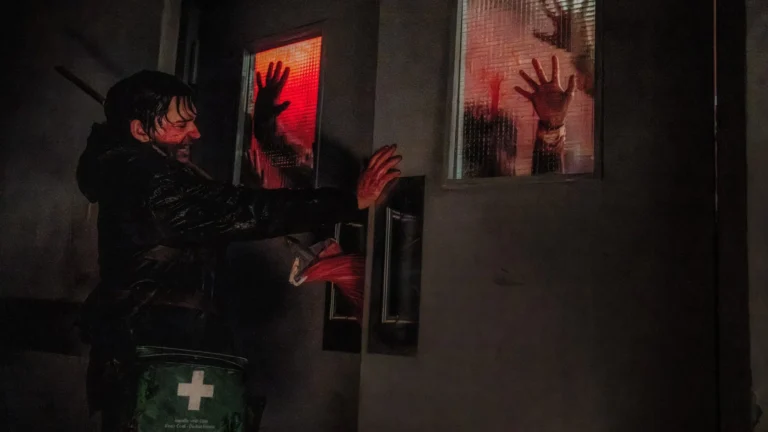
One standout scene in particular — involving a night ambush at a derelict gas station — might just land in the Predator hall of fame. It’s everything the franchise should be: smoky, savage, and soaked in neon-orange firelight. The choreography walks a clever line between clarity and chaos, and the creative kills (including one involving a shattered solar panel) prove that practical filmmaking still beats CGI excess any day.
The flaws – every desert has a few cracks
Now, as much as this review is practically purring in Predator pleasure, Badlands isn’t perfect. The dialogue occasionally leans into macho platitudes, and the third act flirts with overexplaining the lore. (Yes, we get it, the Predator isn’t just hunting — it’s “learning.”) The film also suffers from one or two pacing hiccups. A midsection subplot involving scavengers who exist largely to demonstrate new weaponry could have been trimmed with zero narrative loss.
Still, these cracks are cosmetic. They don’t break immersion; they just remind you that, yes, you’re watching a franchise entry, not high art. But then again, Predator films were never about art — they were about aesthetic brutality. And judged on that scale, Badlands delivers in spades.
The sound of fear
Sound design rarely gets enough credit in action horror hybrids, but here it’s half the experience. The crunch of bones, the pulse of alien gadgets, the low hum of desert wind — every layer builds atmosphere. Composer Marco Beltran’s score deserves serious mention too. It’s a masterclass in restraint: tribal percussion mixed with eerie stillness, evolving from tension to outright panic without ever drowning the scene. The music understands silence is often the loudest sound you can play.
Why it works – the return to simplicity
In the end, Predator: Badlands succeeds because it remembers that simplicity isn’t the enemy of creativity. When studios overcomplicate alien lore or add unnecessary mythology, they forget what audiences really want — that electric mix of thrill, fear, and awe. This film cuts through the noise, gives us one terrifying creature, a small group of flawed humans, and a ruthless game of survival. No crossover gimmicks, no comic-book energy. Just pure dread under a merciless sun.
And maybe that’s the point the franchise has been missing since 1987: it’s never been about the weapons or lore; it’s about the feeling of being utterly outmatched, staring into something ancient and unstoppable, and fighting anyway.
Final thoughts
Predator: Badlands is the surprise evolution fans didn’t dare hope for — a film that respects its roots while daring to expand. It’s violent but not mindless, tense but not joyless, and beautifully shot in ways that elevate it above the pulp label it’s destined to carry.
Sure, it’ll never dethrone the original; that film remains untouchable — lightning in a bottle (or, more accurately, plasma in a shoulder cannon). But Badlands doesn’t try to. It just wants to tell a damn good story, scare you a little, and remind everyone that the hunt is still the best part of being human.
So yes — an 8 out of 10, proudly earned. The dialogue wobbles, the pacing dips, but when this film hits, it hits like a plasma bolt to the chest. Heat, honour, horror — Predator: Badlands blends them all into a sci-fi western nightmare worth every bead of sweat.
If the hunt continues, let’s hope it stays out here, in the sun-blasted wilds, where the only thing deadlier than the Predator is hope itself.